DATA CENTERS
Arizona Voters Are Wary of Data Centers—but Are They Getting the Whole Story?
A new Arizona poll should get the attention of anyone involved in technology, energy, economic development or local government.
According to the latest Arizona Public Opinion Pulse from Noble Predictive Insights, a majority of registered Arizona voters oppose additional large data-center development. Only 30% support additional development, while 13% remain unsure. More strikingly, 35% strongly oppose additional data centers, compared with just 9% who strongly support them.
When voters were asked to weigh economic development against concerns about water, electricity and infrastructure, 61% favored limiting additional development, compared with only 18% who favored encouraging it for investment and tax revenue. That preference crossed party lines: 54% of Republicans, 71% of Democrats and 61% of Independents chose limits.
Those numbers matter. But they also raise another important question:
What information are voters using to form their opinions?
There is no question that data centers create legitimate policy challenges. They can consume enormous amounts of electricity, and some cooling technologies use significant amounts of water. Communities should ask hard questions before approving them.
But there is also an extraordinary amount of misinformation circulating about data centers—and we now have evidence that at least some of that information has been deliberately amplified by foreign-operated social-media accounts.
A Chinese Bot Farm Entered the Data-Center Debate
On August 28, reports emerged that X had identified what it described as a Chinese-operated bot farm consisting of approximately 200,000 accounts. According to X, about 200 accounts were posting material that could manipulate the American debate surrounding AI data centers and energy policy, including amplifying concerns about electricity prices and grid strain.
That deserves attention, particularly because America and China are competing for leadership in artificial intelligence.
But this discovery should not be interpreted to mean that Americans who oppose data centers are bots or that legitimate concerns aren't real. Independent researchers examining some of the identified accounts found very little engagement, and reporting indicates that genuine grassroots opposition to data centers exists across the country.
Both things can be true: Americans can have legitimate concerns about data centers, while foreign influence operations simultaneously attempt to exploit those concerns.
That is exactly why separating facts from fear is so important.
Let's Talk About the Facts
First, data centers use a lot of electricity.
There is no reason to pretend otherwise. The U.S. Department of Energy reported that data centers consumed approximately 4.4% of America's electricity in 2023 and projected that they could consume between 6.7% and 12% by 2028. A newer Lawrence Berkeley National Laboratory update estimates data centers could represent roughly 9.5% to 15.3% of U.S. electricity consumption by 2030.
That means Arizona absolutely must plan for generation, transmission and distribution before approving enormous new loads. But many data centers bring their own power generation and the excess is additional power generation that the ratepayers did not fund.
But another widespread claim—that ordinary Arizona families will simply be handed the bill for all that infrastructure—leaves out an important part of the story.
The Arizona Corporation Commission held a large-load workshop this year specifically addressing this issue. Participants discussed the principle that large users that cause additional system costs should pay those costs rather than shifting them onto other customers. Protections can include minimum bills, longer contracts, collateral requirements and direct assignment of generation and transmission costs.
SRP similarly says new large-load customers must pay upfront for infrastructure upgrades identified through its Large Customer Integration Process. Its pricing structure also imposes minimum billing requirements on qualifying large customers.
APS says it is pursuing the same basic principle. Its proposed structure would require extra-large customers to cover the infrastructure necessary to serve them rather than shifting those costs to residential customers. The APS rate case addressing these issues remains before the Arizona Corporation Commission, so some proposed protections have not yet received a final decision.
What About Water?
This is probably the issue where the phrase "data center" is least useful by itself.
Data centers are not all built the same way.
Past cooling systems can consume substantial quantities of water through evaporation. DOE guidance specifically acknowledges that cooling towers can have significant water requirements.
But newer facilities can use very different technologies. The Department of Energy notes that modern facilities using closed-loop cooling can dramatically reduce water consumption because water is recirculated through the cooling system rather than continuously consumed through evaporation.
That distinction matters tremendously in Arizona.
Instead of asking simply, "How much water do data centers use?" we should be asking:
What cooling technology will this particular facilityuse? Where will its water come from? How much will it consume annually? Will it use potable or reclaimed water? What happens during extreme heat? And who pays for the infrastructure?
Those questions produce far more useful answers than blanket claims that every data center either consumes enormous quantities of water or uses virtually none.
President Trump Has Made Data Centers a National Priority
There is also a national-security component to this debate.
President Donald Trump has explicitly supported expanding American AI and data-center infrastructure. In July 2025, he signed an executive order making rapid data-center infrastructure development a priority and directing federal agencies to streamline permitting for qualifying projects. His administration described AI infrastructure as important to America's economic prosperity, scientific leadership and national security.
The administration also announced more than $90 billion in AI and energy investments in Pennsylvania, including billions for data centers and supporting energy infrastructure.
The policy argument is straightforward: artificial intelligence requires computing power, computing power requires data centers, and whichever nations control the technology and infrastructure underlying AI will have an enormous economic and strategic advantage.
China certainly understands that.
Americans should too.
Arizona Needs Facts, Not Fear
The Noble poll tells us something important: Arizona voters are concerned.
We shouldn't dismiss those concerns.
If residents are worried about water, show them the project's actual water requirements.
If they're worried about electricity, show them where the additional generation will come from.
If they're worried about their electric bills, explain the rate structures and contractual protections designed to prevent costs from being shifted onto existing customers.
If they're worried about infrastructure, show them who is paying for it.
And if a proposed project cannot satisfactorily answer those questions, local officials should demand better answers.
But we should apply the same standard to claims made againstdata centers.
A meme is not evidence. A viral Facebook post is not an engineering study. A frightening number without context isn't analysis. And now that a foreign influence operation has reportedly attempted to insert itself into America's data-center debate, verifying information before sharing it becomes even more important.
Arizona does not have to choose between blindly approving every data center and banning them.
There is a third option:
Demand responsible development.
Require developers to disclose their water needs. Require realistic energy plans. Protect existing ratepayers. Require appropriate infrastructure. Evaluate each project based on its technology, location and actual impacts.
Then let the facts—not rumors, social-media algorithms, political narratives or foreign bot farms—drive the decision.
The future of technology is being built right now.
Arizona should make sure we understand exactly what we're saying yes to—and exactly what we're saying no to.
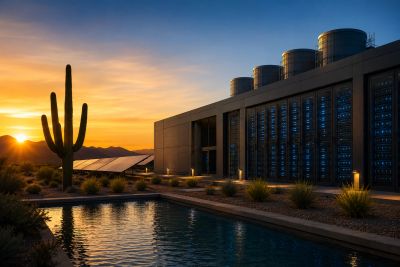
Data Centers and Arizona's Power Grid: The Facts
If you follow the news or social media, you have probably heard some version of this argument: Data centers are coming to Arizona, they are going to consume enormous amounts of electricity, and residential customers will be stuck paying for the power plants, transmission lines and substations needed to serve them.
There is just one problem.
That is not how Arizona's regulatory system works.
Earlier this year, I attended the Arizona Corporation Commission's Large Load Users Development Workshop. Representatives from Arizona Public Service (APS), Salt River Project (SRP) and Tucson Electric Power (TEP) all made presentations about how large-load customers — including data centers and advanced manufacturing facilities — connect to Arizona's electric grid.
What I heard was considerably different from many of the sound bites we continue to hear.
A Data Center Doesn't Simply Plug Into the Grid
Connecting a massive new electrical customer isn't like calling the power company and asking for service at a new house.
Utilities must determine whether the grid can safely and reliably handle the requested load, what new infrastructure may be necessary and whether additional generation, transmission lines, substations or other improvements will be required.
APS, TEP, and SRP told the Commission they are receiving more requests from prospective large-load customers than their systems can currently accommodate. Both utilities have developed queue processes to evaluate and narrow those requests. APS has also proposed long-term contracts and upfront financial commitments from large customers to help ensure those customers — rather than residential and small-business ratepayers — bear the costs and risks associated with new infrastructure.
TEP similarly says it conducts detailed system studies before determining whether a proposed data center can be served without harming reliability or affordability for existing customers. If service is possible, contracts can then establish how the customer will pay its own costs and for infrastructure dedicated to serving it.
This is not an overnight process. Large-load projects require extensive engineering, planning, financial commitments and, depending on the project, regulatory approvals before power begins flowing.
And those protections matter.
"Growth Pays for Growth"
The principle repeatedly emphasized by the Arizona Corporation Commission is simple:
Growth pays for growth.
At the April workshop, there was broad agreement among utilities, regulators, consumer advocates and industry representatives that the "cost causer" should bear the costs it creates rather than shifting those costs to existing customers.
Arizona's approach can include special large-load rates, Energy Supply Agreements, minimum-bill requirements, collateral and credit requirements, termination provisions and direct assignment of generation, transmission and distribution costs.
APS, for example, says its approach for extra-large energy users includes minimum bills, collateral requirements and opportunities for customers to make upfront contributions toward new infrastructure through long-term agreements.
TEP's agreement for the initial phase of a proposed Pima County data center provides a real-world example. The ACC says the agreement requires protections including minimum payments, financial security and termination provisions. TEP also confirmed the data center would cover construction costs for necessary line extensions and a new switchyard.
That is an important part of this discussion that is often missing from social media.
The ACC Just Added More Protections
On August 12, the Arizona Corporation Commission unanimously approved another measure aimed specifically at protecting customers from the costs associated with large-load growth.
This time, the focus was Arizona's electric cooperatives.
Arizona Electric Power Cooperative, Duncan Valley Electric Cooperative, Sulphur Springs Valley Electric Cooperative, Mohave Electric Cooperative, Graham County Electric Cooperative and Trico Electric Cooperative jointly sought a standardized process for handling new large-load customers.
These cooperatives are already talking with multiple large-load businesses interested in locating facilities in their service territories.
Under the new framework, large-load service agreements will come before the Commission through a standardized application process.
ACC Utility Division staff must consider at least three important questions:
- Is the agreement in the public interest?
- Are the rates being charged reasonable?
- Does the agreement ensure that other customer classes are not subsidizing the large-load customer's commercial activities?
Commissioner Kevin Thompson made the purpose particularly clear, saying large-load customers will continue to be responsible for costs associated with their commercial service, including new infrastructure and transmission construction.
Chairman Nick Myers described the policy as a way for rural Arizona to capture economic development without having existing utility customers subsidize it.
Why This Matters for Rural Arizona
The latest ACC action is especially important because the data center discussion is no longer limited to Phoenix, Mesa, Chandler or other major metropolitan areas.
Large-load developers are increasingly looking at rural Arizona.
That creates both opportunities and legitimate concerns.
A large industrial project can require tremendous electrical capacity. If a utility builds expensive infrastructure based on a developer's projections and that project is delayed, downsized or abandoned, somebody could potentially be left paying for those investments.
That is exactly why minimum billing requirements, collateral, long-term contracts, termination provisions and upfront financial commitments matter.
Arizona shouldn't blindly approve every large-load project that comes along.
But we also shouldn't reject economic development based on the assumption that residential customers automatically have to pay for all the infrastructure needed to serve it.
Arizona Has Been Working on This for Some Time
The August decision didn't come out of nowhere.
The ACC opened a formal docket on data centers and large-load customers in April 2025. At that time, Commissioner Thompson said the Commission needed to ensure residential and small-business customers were not burdened with infrastructure costs created by these massive new users. The Commission also stated then that Arizona's data center industry had, to date, been paying its fair share of power-generation and infrastructure expansion under existing rate structures and regulatory practices.
The Commission continued that work through the April 2026 workshop.
Now it has established additional protections for electric cooperatives serving rural Arizona.
This isn't a regulatory system ignoring the issue.
It is a regulatory system actively trying to stay ahead of it.
Don't Let a Sound Bite Replace the Facts
I understand why people are concerned about data centers.
They use tremendous amounts of electricity. Some proposed facilities are enormous. Arizona is growing quickly, and residents have every right to ask whether our electrical system can keep up.
Those are legitimate questions.
But there is a difference between asking hard questions and assuming the answers.
When someone tells you that your electric bill is going up because a data center is coming to Arizona, ask another question:
Who is actually paying for the infrastructure required to serve that data center?
The answer may be considerably different from what you have been hearing.
Arizona's regulators have made their policy direction increasingly clear: large-load customers should pay the costs they create.
That doesn't mean Arizona should stop scrutinizing these projects. Quite the opposite. We should continue demanding strong contracts, adequate financial guarantees, careful engineering studies and safeguards against stranded costs.
But the conversation needs to be based on facts.
Data centers and other large-load users should pay their own way. Arizona's Corporation
Commission has been taking steps to make sure they do.

Today's Data Center has Responded to Citizen Concerns
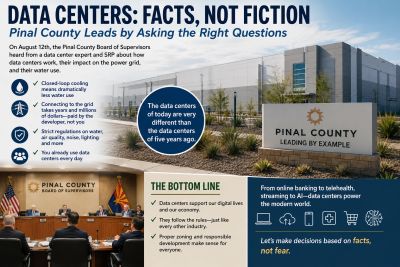
On August 12, the Pinal County Board of Supervisors heard a presentation from a data center expert who explained how data centers work, why they are needed, and—perhaps most importantly—how much the industry has changed.
That presentation was followed by a presentation from Salt River Project (SRP) explaining how large-load customers such as data centers connect to the electric grid.
I believe Pinal County is leading by example. Other counties and cities across Arizona—and frankly across the country—should consider doing the same thing: bring in the experts, ask questions, separate fact from fiction, and make decisions based on current technology rather than outdated information.
There is an enormous amount of misinformation circulating about data centers, particularly regarding water consumption and their impact on the power grid.
The Technology Has Changed
One of the most important points made during the presentation was simple: the data center being built today is not the same data center that was being built five or ten years ago.
Older data centers could consume tremendous amounts of water for cooling. That history has understandably created concerns in a state like Arizona, where every discussion about major development eventually comes back to water.
But the industry has responded.
Newer facilities are being designed with closed-loop cooling systems that dramatically reduce ongoing water consumption. Once that concern is addressed, however, another question often immediately appears: What happens when the water in that closed-loop system eventually needs to be discharged?
That is a legitimate question, but it is also something our existing regulatory structure is designed to address.
Think about the radiator in your car. When the coolant is flushed, you cannot simply dump the old fluid wherever you want. It has to be handled and disposed of properly. Industrial facilities face regulations governing water discharge and waste as well.
Data centers do not receive a free pass.
States, counties, cities and regulatory agencies already impose requirements involving water, wastewater discharge, noise, lighting, air quality and numerous other environmental and operational issues. Companies that fail to comply can face financial penalties and potentially more serious consequences.
Approving a project does not mean those regulations suddenly disappear.
Where Should We Put Them?
The discussion also highlighted another challenge facing the industry: NIMBYism—"Not In My Backyard."
Early in the meeting, one supervisor commented that data centers should be built in the middle of nowhere. Later, the same supervisor expressed concern about locating one near farmland because it would stand out and did not belong there.
I am not pointing this out to criticize that supervisor. In fact, I think it perfectly illustrates the dilemma.
If a data center should not be near homes, should not be near farmland, and should not be visible in rural areas, where exactly should it go?
This is why zoning matters.
I believe there is a proper place for everything. If property is zoned residential, changing it to accommodate a massive industrial project generally would not make sense. But when land is appropriately zoned industrial, a data center that meets the community's other requirements should be considered like other industrial uses.
Most people probably drive past data centers without even realizing it. From the outside, many resemble large warehouses or other industrial buildings.
What About the Power Grid?
Another major misconception is that data centers simply arrive, plug into the electric grid and leave residential customers paying for the infrastructure necessary to serve them.
The SRP presentation helped explain why that is not how the process works.
Connecting a major large-load customer can take years of planning. New substations may be required. Transmission infrastructure may need to be constructed. Grid upgrades may be necessary. These projects involve extensive engineering, planning and significant investment.
Connecting a data center is nothing like moving across town, calling your utility company three days before the move, and asking them to turn on the electricity.
Large-load customers go through an extensive process before receiving service, and the infrastructure required to serve them can represent millions of dollars in investment.
That is an important distinction when discussing another claim circulating online—that data centers are responsible for increasing everyone's utility bills.
We should absolutely scrutinize utility rates and make certain ordinary ratepayers are protected. But we should also understand how large-load customers actually connect to the system before assuming residential customers are automatically footing the bill.
When a data center brings its own power generation, that can create additional opportunities. The electricity being generated is not fundamentally different simply because it is associated with a data center. Natural gas turbines, for example, are already part of the generation mix used by utilities to provide electricity to homes and businesses.
You Already Use Data Centers Every Day
Lost in much of this debate is a basic fact: we all use data centers.
Every time you open an internet browser, access online banking, store photographs in the cloud, stream entertainment, use an app, make an online purchase, visit a patient portal or interact with countless other digital services, somewhere behind that activity is data infrastructure.
Your bank uses data centers. Your doctor's office uses data centers. Businesses use them. Schools use them. Governments use them.
Artificial intelligence is certainly increasing demand for computing capacity, but AI is not the only reason more data centers are needed. Our entire economy and daily lives have become increasingly digital.
Data centers have existed for decades. The difference today is that they are larger, more visible and receiving far more public attention.
That increased scrutiny is not necessarily a bad thing. Communities should ask questions. Supervisors and councilmembers should demand answers about water, electricity, noise, infrastructure, zoning and costs.
But those questions need to be answered using today's facts and today's technology, not assumptions based on what a data center looked like years ago.
That is why I applaud Pinal County for holding this discussion publicly. The supervisors asked questions, challenged the presenters and had an opportunity to learn directly from people who understand the industry and the electric grid.
Arizona is going to continue facing proposals involving data centers and other large technology projects. We can simply say "no" because we are afraid of what we have heard, or we can educate ourselves, establish appropriate regulations, put projects in properly zoned locations, protect residents and taxpayers, and evaluate each proposal on its individual merits.
Pinal County chose education before judgment.
That is an example other governments should follow.
Data Centers: Separating Myths from Facts
t has become fashionable to oppose data centers. Social media, advocacy groups, and sensational headlines have created an environment where fears often spread faster than facts. Legitimate concerns deserve discussion, but misinformation should not drive public policy.
Here are some of the most common myths—and the facts behind them.
Myth #1: Data Centers Are Draining Local Water Supplies
The Claim: Data centers use millions of gallons of water every day and are depleting communities.
The Facts:
Water use varies greatly depending on cooling technology, climate, and the source of water. According to Brookings Institution research, some large facilities can consume significant amounts of water, but many use closed-loop systems, air cooling, or reclaimed water.
A 300,000-gallon-per-day facility and a 5-million-gallon-per-day hyperscale campus are not the same thing. The highest numbers often cited represent the largest facilities and should not be treated as the norm.
Source: Brookings Institution; "Small Bottle, Big Pipe" (2026).
Myth #2: Data Centers Are Driving Up Everyone's Electric Bills
The Claim: Your power bill is increasing because of data centers.
The Facts:
According to the Department of Energy and Lawrence Berkeley National Laboratory, data center electricity demand is growing rapidly. However, electric rates are determined by utility companies and regulators. Factors such as fuel prices, transmission costs, generation investments, and rate structures all influence electricity prices.
In many states, large users pay their own infrastructure costs, reducing impacts on residential customers.
Source: DOE and Lawrence Berkeley National Laboratory, 2024 United States Data Center Energy Usage Report.
Myth #3: Data Centers Create Massive Heat Islands
The Claim: Data centers are creating microclimates and heating neighborhoods.
The Facts:
Many of these claims originate from a recent preprint study that has not undergone peer review. Temperature changes are influenced by roads, parking lots, rooftops, loss of vegetation, and urban growth.
All buildings generate heat. Data centers are not unique in this regard.
Scientists themselves acknowledge that more study is needed.
Myth #4: Data Centers Are Giant Fossil Fuel Plants
The Claim: Data centers constantly run diesel generators and pollute communities.
The Facts:
Backup generators are common at hospitals, airports, and manufacturing facilities. Their purpose is emergency power, not continuous operation.
Testing periods are typically brief and regulated under federal and state environmental laws.
The existence of backup generators does not mean a data center is functioning as a power plant.
Source: EPA Clean Air Act guidance.
Myth #5: Data Centers Create Few Jobs
The Claim: Data centers provide little economic value.
The Facts:
Data centers are infrastructure projects, not labor-intensive factories. Their economic value extends beyond permanent employees.
Benefits include:
- Construction jobs.
- Billions of dollars in private investment.
- Utility infrastructure improvements.
- Tax revenue for schools and local governments.
- Secondary business growth.
Judging data centers solely by employee count ignores their broader economic impact.
Source: Brookings Institution; Georgia State Economic Analysis.
Myth #6: Data Centers Destroy Property Values
The Claim: Property values decline near data centers.
The Facts:
Property values are influenced by many factors including buffers, landscaping, noise controls, site design, and the strength of the local housing market.
Research conducted by George Mason University's Center for Regional Analysis found that homes near data centers in Northern Virginia actually sold for higher prices. However, that does not mean every project will increase property values.
Broad claims in either direction oversimplify a complicated issue.
Source: George Mason University Center for Regional Analysis.
Myth #7: Data Centers Are Environmental Disasters
The Claim: Data centers are inherently harmful to the environment.
The Facts:
Like every industry, data centers have environmental impacts that should be studied and managed. But they are also becoming increasingly efficient.
Modern facilities employ:
- Reclaimed water.
- Closed-loop cooling systems.
- Renewable energy contracts.
- Improved energy efficiency.
- Advanced recycling programs.
No industry is impact-free. The question is whether facilities are planned and regulated responsibly.
Myth #8: Secrecy Means Data Centers Have Something to Hide
The Claim: Code names and nondisclosure agreements prove developers are hiding something.
The Facts:
Code names and confidentiality agreements are common throughout commercial real estate and corporate site selection. They protect negotiations and proprietary information.
Communities still deserve transparency regarding:
- Water usage.
- Power demand.
- Traffic impacts.
- Noise mitigation.
- Environmental controls.
Lack of information should lead to questions—not assumptions.
The Bottom Line
None of this means every data center belongs everywhere. Communities deserve answers, transparency, and thoughtful planning. Poorly designed projects should be challenged.
But data centers are increasingly being judged by headlines, social media posts, and worst-case scenarios rather than facts.
America's digital economy runs on data centers. Every email, smartphone app, streaming service, online purchase, artificial intelligence platform, and cloud-based medical record depends on them.
Public policy should be guided by sound science, peer-reviewed research, and facts—not fear, speculation, or internet soundbites.
Sources
- U.S. Department of Energy and Lawrence Berkeley National Laboratory, 2024 United States Data Center Energy Usage Report
- Brookings Institution, AI, Data Centers, and Water
- Brookings Institution, The Local Implications of Data Centers for Rural Communities
- World Resources Institute, 7 Ways Data Centers Affect U.S. Communities
- Han, Li, Wierman, and Ren, Small Bottle, Big Pipe: Quantifying and Addressing the Impact of Data Centers on Public Water Systems
- Environmental Protection Agency, Clean Air Act Guidance for Data Centers
- George Mason University Center for Regional Analysis

Luke Air Force Base Clears Path for Project Baccara as Key Hearings Approach
Last week, an important milestone was reached for one of the West Valley’s most discussed development proposals. Luke Air Force Base has officially indicated that Project Baccara can move forward, clearing a major compatibility hurdle for the proposed development.
Project Baccara is a planned data center campus with on-site power generation proposed for county land located between Surprise, Glendale, and Luke Air Force Base. The project site is already zoned for industrial use, but the development must still go through the public approval process with Maricopa County.
Two key hearings are now on the calendar. The Maricopa County Planning and Zoning Commission is tentatively scheduled to hear the case on April 9, followed by a Board of Supervisors vote scheduled for May 6. These meetings will give residents and stakeholders an opportunity to weigh in before any final decisions are made.
What makes Project Baccara different from many traditional data center proposals is how it addresses several of the concerns often raised by residents.
First, the project plans to use reclaimed water from nearby industry rather than groundwater, significantly reducing its impact on the local water table—an issue that has become increasingly important across Arizona as the state continues to manage long-term water resources.
Second, the facility is designed to include 19 power-generating turbines capable of producing more electricity than the data center itself requires. The excess power would be sold into the wholesale energy market, adding additional electricity to the West Valley’s growing power needs without passing costs on to local ratepayers.
The West Valley continues to see rapid growth in both population and technology infrastructure. Data centers have become an important part of that economic ecosystem, supporting cloud computing, artificial intelligence, and the digital services used by businesses and residents every day.
As the approval process moves forward, community members will have opportunities to learn more about the project and share their perspectives during the upcoming hearings.
With Luke Air Force Base compatibility confirmed and pubic hearings approacing, Project Baccara is now entering the most important stage of its review process.Project Baccara
I strongly support Project Baccara because it represents the kind of thoughtful, forward-looking development the West Valley needs. As our communities continue to grow, so does the demand for reliable power, technology infrastructure, and responsible land use. Project Baccara addresses many of the concerns residents typically raise about large developments. The site is already zoned for industrial use, the project will rely on reclaimed water rather than groundwater, and it will actually generate more power than it consumes—selling excess energy into the wholesale market and helping strengthen the region’s energy supply without increasing costs for local ratepayers. At the same time, projects like Baccara bring high-quality jobs, infrastructure investment, and long-term economic stability to our area. With Luke Air Force Base confirming compatibility, this project shows that growth in the West Valley can be done responsibly while supporting both our economy and our community.

Arizona Corporation Commission Approves Project Baccara After Extensive Review
On February 4th, the Arizona Corporation Commission held a public hearing to determine whether Project Baccara meets the regulatory standards required of public utilities. The Commission relied heavily on the findings and prior vote of the Line Siting Committee, using that earlier hearing as a guide in its deliberations.
The purpose of this hearing was narrow but important: to evaluate whether Project Baccara complies with public-utility guidelines related to electric interconnection, the on-site natural gas generation station, and water usage.
One of the most significant issues—water—was addressed directly. Project Baccara plans to use reclaimed water sourced from a local brewery, a decision that dramatically reduces any impact on the regional water table. This approach responds to one of the most common and legitimate concerns raised about data centers in Arizona.
Energy reliability was another key topic. Baccara is scheduled to have discussions with Arizona Public Service to draft a purchase agreement that would allow APS to buy excess power generated by the project’s 17 natural gas turbines. Even on the hottest day of the year, Project Baccara anticipates needing power from no more than 15 turbines at any given time, ensuring built-in redundancy and grid support. The first turbine is expected to come online in early 2028.
Public comment included three speakers in favor of the project and ten opposed. Speaking in support was Cepand Alizadeh, Esq., representing the Arizona Technology Council, who emphasized the importance of advanced infrastructure and innovation for Arizona’s economic future. The Sierra Club spoke in opposition, along with several residents from across the Valley, many of whom live near the proposed site.
One opposing speaker became unruly, challenging the Commission’s long-standing three-minute public comment rule—applied equally to all speakers—and interrupted testimony while others were speaking. Immediately prior to the vote, he shouted, “The fix is in.”
Unfortunately, moments like this underscore a broader misunderstanding. While residents absolutely have the right to raise concerns, the appropriate venue for many land-use and zoning-related objections will be later this year before the Board of Supervisors—not during an ACC hearing focused on utility compliance.
After hearing all testimony and reviewing the record, the Arizona Corporation Commission voted unanimously to approve Project Baccara.
Data centers are not optional luxuries—they are critical infrastructure. Every time we use Google, GPS, ChatGPT, visit a doctor, or fill a prescription, we are relying on systems powered by data centers. The question is not whether they will exist, but whether they will be built responsibly.
Project Baccara directly addressed my own serious concerns by committing to reclaimed water use and on-site power generation that does not increase costs for ratepayers. These innovations represent thoughtful, forward-looking development.
For our community, Project Baccara stands as a rare win-win: supporting economic growth and technological advancement while respecting Arizona’s most precious resources.

PROJECT BACCARA
Are Data Centers the Devil the Public Thinks They Are?
Recently, residents across the Valley have begun pushing back on city approvals of new data center projects, often citing concerns about excessive power and water usage. While these concerns are understandable, they are not always grounded in the full picture. Many modern data centers are shifting toward innovative solutions, including the use of reclaimed or non-potable water for cooling and on-site or dedicated power generation that reduces strain on the existing electric grid. Even in cases where data centers rely on utility power, they are frequently subject to strict agreements that require them to fund necessary infrastructure upgrades. Unfortunately, misinformation has contributed to a negative perception, overlooking the evolving technologies and regulatory safeguards designed to ensure these facilities operate efficiently and responsibly without burdening local communities.
As data centers rapidly expand across the country, they have become one of the most discussed topics among energy regulators, utilities, and policymakers. The growth of artificial intelligence and cloud computing means the United States is in a global race for technological leadership—and data centers are at the heart of that effort. Arizona, with its strategic location and infrastructure, is no exception.
Utilities such as Arizona Public Service have already committed to serving thousands of megawatts of new data center load, with even more potential projects under discussion. While this growth is inevitable, it has raised understandable concerns among residential customers who worry that large energy users could drive up electricity rates or strain the grid.
The key to addressing these concerns lies in a simple but critical principle: growth must pay for growth. When tariffs and energy supply agreements are properly structured, data centers can be required to cover the full cost of the generation and grid upgrades they need—even if projected demand fails to materialize. Regulators and utilities are keenly aware of the risks of cost-shifting and are actively working to prevent residential customers from subsidizing large industrial users.
In fact, when done correctly, data centers can reduce upward pressure on rates. Electric utilities have significant fixed costs, such as power plants, substations, and transmission lines. Adding large, high-load customers spreads those fixed costs across more usage, lowering the average cost per customer. Data centers can also improve grid efficiency by flattening load profiles, allowing utilities to operate their systems more optimally and reduce overall costs.
Beyond rate impacts, data centers offer substantial economic benefits to local communities. In other parts of the country, data center development has significantly reduced residential tax burdens by expanding the tax base. Here in Arizona, recently approved projects are bringing billions in private investment, hundreds of millions in tax revenues for the state and counties, thousands of construction jobs, and long-term, well-paying technical positions. Many developers are also committing additional funds for workforce development, STEM education, and local infrastructure.
The data center conversation should focus on facts, not fear. With sound regulatory oversight and firm adherence to the principle that growth pays for growth, data centers can strengthen Arizona’s electric grid, help keep rates affordable, and serve as powerful engines of local economic development—while advancing national priorities in technology and innovation.
Much of this information was from reading the writings of Nick Myers, Chairman, Arizona Corporation Commission

HEARINGS BEFORE THE LINE SITING COMMITTEE WHO MAKES RECOMMENDATIONS TO THE ARIZONA CORPORATION COM
Takanock LLC is proposing to build a new data center powered by natural gas generators known as Project Baccara in the West Valley on a county island bordered by Glendale, Surprise, and Luke Air Force Base. Because of its location near Luke, the project will require a military compatibility study as well as approval from the Arizona Corporation Commission. I attended part of the recent ACC Line Site Committee hearing, I listened carefully to the sworn testimony presented. Every individual who testified was under oath, and a court reporter documented the proceedings, creating a formal transcript for the public record. The resumes of those presenting before the Commission were exceptionally impressive, beginning with Takanock founder Ken Davies. Davies was the Director of renewable Energy with Microsoft when Microsoft built the first and currently only data center with gas generator in the US. Craig McKesson Chief Commercial Officer for Takanock and previously with T5 Data Centers and Jones Lang LaSalle. And several other
Many citizens who oppose this project continue to ask, why not build this further in the desert. One of the most important takeaways from the hearing was why this specific location was chosen. The property is already zoned heavy industrial, and significant infrastructure is already in place. Massive fiber lines exist due to the site’s proximity to Microsoft, along with existing high-transmission power lines and the close location to Electrical District 7. In addition, the project cannot move forward without explicit approval from Maricopa County which will reflect a compatibility determination from Luke Air Force base. If Project Baccara is not built on this site, it is likely that another similar heavy-industrial project will eventually be proposed based on the zoning alone.
During the hearing, it was explained that all power generated on site will be sold into the wholesale market, after which the project will purchase electricity back from ED7. With the West Valley growing at such a rapid pace, the existing infrastructure alone will not be sufficient for APS to meet the region’s increasing energy demands. This project will add much-needed power to the system at no cost to the ratepayer. In fact, most rate increases approved for APS are driven by the need to build additional infrastructure to keep up with growing electricity demand, which this project helps to address.
For context, data centers exist throughout the country, but only one currently operates with an attached natural gas power plant—located in Cheyenne, Wyoming—and Ken Davies was part of the team that built it during his time at Microsoft. Many who oppose data centers often cite concerns about power consumption and water usage; however, Takanock and Project Baccara have directly addressed these issues through having the natural gas generator on site and using a closed loop water system.
Data centers are not only coming to Phoenix. Nationally, Northern Virginia leads the country with the most megawatts (MW) with 4,934 MW of data center capacity. Phoenix currently has 804 MW, with 1,004 MW under construction and an additional 3,684 MW planned. West Virginia has 1,071 MW under construction and 5,446 MW planned, while the Dallas–Fort Worth region has capacity figures similar to Phoenix. Other major regions at the forefront of data center development include Atlanta, Chicago, Northern California, and the Pacific Northwest.
Engineering details were also discussed. The turbines for Project Baccara have been purchased from Siemens, with delivery expected in December 2027. There will be 18 turbines total. The proposed construction start date is the third or fourth quarter of 2026. The data center itself will be cooled using air conditioning, while the turbines will require water though only on the hottest days of the year. Takanock is currently in discussions with existing industries in the area about potentially using recycled water to cool the turbines, which would further reduce the project’s overall water impact.
Public concerns about this project continue to focus on noise, water use, air quality, property values, and general safety. These concerns are understandable, and they deserve to be taken seriously. However, it is also important to acknowledge that this land is already zoned for heavy industrial use. This raises an important question: Will those who oppose Project Baccara accept any heavy-industrial project at this location? With the rapid growth occurring in the West Valley, additional energy generation will be required regardless. If this project does not move forward, it is very likely that another energy project will eventually be proposed for the same site.
Finally, it is worth noting that the Arizona Technology Council has come out strongly in support of Project Baccara. Their representative spoke publicly at the hearing about the growing data and energy demands in the West Valley and the importance of projects like this to support our modern, technology-dependent society.
At this time, after attending the hearing, reviewing the facts, and listening to sworn expert testimony, I continue to support Project Baccara. Data centers are a critical part of our economy, our infrastructure, and our daily lives. With strict state and county oversight of air quality, noise, and environmental standards, and with thoughtful planning and transparency, this project can move forward responsibly while helping meet the growing needs of the West Valley.
MY VISIT TO A DATA CENTER, THE BACCARA SITE, AND A GAS GENERATING FACILITIY
On December 3rd at approximately 10:30 a.m., I took a field trip to the existing data center located on Citrus Road in Goodyear to see firsthand what a fully operating facility is like in a real-world setting. Directly across the street, cattle were grazing and lying peacefully in the field, enjoying the cool morning breeze. It was a striking contrast—modern high-tech infrastructure on one side of the road and quiet agricultural life on the other.
When I stepped out of my car, I intentionally paused to listen closely for any sound coming from inside the fenced perimeter of the data center. I heard nothing from the facility itself—no constant hum, no mechanical noise, no cooling system sounds. The only noise present was regular ambient sound and the cows occasionally mooing across the road. I then drove around to the opposite side of the building. There, I could clearly hear construction equipment operating on the neighboring property, but again, there was no audible noise coming from the data center itself.
After my admittedly amateur sound test at the operating facility, I drove to the proposed site for Project Baccara. It must have been a busy training day for Luke Air Force Base, because jets were flying overhead performing repeated touch-and-go exercises every few minutes. The proposed project site is bordered by Peoria Avenue, 143rd Avenue, Olive Avenue, and Bullard Avenue. The surrounding area is already heavily industrial, with countless warehouses, rail lines running along Olive, and frequent freight activity. While there are still a few remaining farms, scattered homes outside of subdivisions, and citrus sales in the area, the overall character of this location is clearly shifting toward industrial use.
Just north of the property are the Copper Canyon Ranch and Rancho Gabriela subdivisions. These neighborhoods sit across the street and are enclosed behind a wall, separated from the industrial corridor. This is a growing industrial zone, and the presence of numerous diesel trucks servicing the surrounding warehouses is already a daily reality for the area.
I truly understand and respect the concerns being raised by nearby residents—concerns about noise, safety, air quality, and quality of life are always valid and deserve to be heard. However, standing on this site and observing the existing land use and surrounding development, it is also clear that this area has already transitioned into an industrial corridor. In many ways, the horse has already left the barn.
My visit to the Goodyear data center reinforced an important point: a properly designed and operated data center can exist quietly within a broader industrial area without creating the kind of continuous noise many fear. Real-world observation matters, and what I personally experienced was a facility that blended into its environment far more quietly than expected.
My field trip would not be complete without touring a gas generation station. So I made a point to visit an operating natural gas generation facility to better understand the real-world impacts.
I went to the Agua Fria Generating Station on Northern Avenue, which houses five combustion turbine generators with a total capacity of 722 megawatts. I walked along two sides of the property and listened carefully for operational noise. The only sound I heard from within the facility was a forklift moving pallets. Otherwise, there was only normal ambient noise. In fact, the traffic on the street was noticeably louder than anything coming from the plant itself. There were also residential homes located directly across the street from the facility, illustrating how closely this type of infrastructure can safely and quietly coexist with nearby neighborhoods.
In conclusion, the Takanock Project Baccara represents a carefully planned and forward-looking investment in the future of the West Valley. As our region continues to grow at an unprecedented pace and our reliance on technology only increases, the need for reliable, locally generated power is undeniable. Based on what I have seen firsthand and learned through sworn testimony and site visits, this project is designed to responsibly meet that demand while operating within strict regulatory oversight. Project Baccara will help ensure that the West Valley can continue to support innovation, growth, and the ever-evolving technologies that shape our daily lives.
On December 4, 2025 the Line Siting Committee who recommends to the Arizona Corporation Commission voted 8 - 1 to approve Takanock Project Baccara. The Arizona COrporation COmmission will vote in January or Frbruary of 2026. The project must finish the approval process with Luke Air Force Base for their final determination. Then the project will move to the P&Z Committee and finally the Maricopa County Board of Supervisors probably early next year.
Project Baccara: A Proposed Data Center - A Transparent Process and a Community Conversation Worth having
Project Baccara has sparked a lot of discussion in the West Valley, and rightly so. Any project of this scale deserves close public scrutiny. Over the past several months, many residents have raised questions about water, noise, power generation, environmental impact, and the proximity to nearby homes. Those concerns are valid, and they should be addressed openly.
To their credit, Takanock, the developer behind Project Baccara, has been extremely transparent throughout this process. They have hosted multiple open house events, offered detailed Zoom presentations, and responded quickly to emailed questions. Whether one supports the project or not, the level of accessibility and information-sharing they have provided is noteworthy.
Initial Feedback from Regulators and Local Cities
When I first heard about Project Baccara, I reached out to the Arizona Corporation Commission (ACC). Their response was twofold:
- A project like this is needed, and
- This location is appropriate for such a facility.
Because the site sits within a county island, I also contacted council members from several nearby cities. Each city indicated they had questions and wanted more details, but importantly, none expressed opposition to the project at this time.
After Four Meetings, Here are My Takeaways
I have personally attended two in-person open houses and two Zoom briefings. My primary concerns from the beginning were straightforward: water, noise, and power. These are finite, precious resources, and we should never take them for granted. I also strongly believe in property rights — both the rights of the project owner AND the rights of the neighbors who want to continue living peacefully.
Here’s what I learned:
Water Use: A Closed-Loop System With Reclaimed Water
Project Baccara plans to use a closed-loop cooling system, meaning water is recirculated rather than constantly consumed. Even more importantly, Takanock is working with a neighboring industrial facility discussing utilizing reclaimed water from them rather than drawing from local groundwater.
The total projected water use is approximately 100 acre-feet per year — significantly lower than many industrial users in Maricopa County. Protecting water resources is one of my top priorities, and the presentation of these details made a meaningful difference in evaluating the project.
Power Generation: A Local Benefit
The project includes a natural gas power plant designed to supplement the grid during high demand periods. Electricity generated onsite would be sold back to the APS which would help Electrical District 7, providing a local, flexible backup power source.
With our exploding population and massive reliance on technology, having additional grid stability is a public benefit, not a burden.
Noise Levels: Quieter than Current Ambient Sound
One of the most surprising facts presented was that the noise generated by the facility will be lower than or equivalent to current ambient noise levels in the area.
A comparable facility, the SRP Santan Generating Station, has virtually no noise complaints from nearby residents. For a project that includes data halls and a gas turbine, this was encouraging information.
Air Quality: Within Maricopa County Standards
Air quality is a legitimate concern, especially for projects involving combustion. According to Takanock’s environmental assessment, emissions from the gas plant will remain well within Maricopa County Air Quality Department standards, with ongoing monitoring built into the project to ensure compliance.
Proximity to homes: Respecting Neighbor Rights
The project area is relatively isolated:
- 6 homes within 0.5 miles
- 110 homes within 1 mile
- 630 homes within 1.5 miles
Every one of these households has the right to clean air, quiet living, and stable water access. Those rights must be protected. The data presented so far suggests that the project will not compromise those expectations, but continuing oversight is essential.
The Role of Data Centers in Modern Life
Whether we like it or not, we live in a digital world. Every time we:
- Use GPS
- Access the internet
- Stream content
- Use cloud storage
- Interact with AI
…a data center makes it possible.
They are already around us — and most people never even notice they are there. If we expect fast, reliable technology, data infrastructure must grow with us.
My Position Today
At this point, based on the information provided and after personally attending multiple meetings, I am in favor of Project Baccara.
That said, I respect that some residents disagree. What concerns me is that a lot of misinformation is spreading online, and people are forming opinions without attending the open houses or asking direct questions.
If you have concerns or want clarification, I encourage you to email Takanock directly. They have consistently replied quickly and thoroughly. There is no need to rely on rumors when accurate information is readily available.

Data Centers in Maaricopa County: Why They're Needed and the Facts and Myths Surrounding Them
As Arizona continues to grow, one of the fastest-rising industries in Maricopa County is data infrastructure — specifically, data centers. These large, often windowless facilities have become essential to powering our daily lives, even though they’re rarely noticed by most residents. Yet with new projects proposed across the West Valley, from Surprise to Buckeye, many community members are asking: Do we really need them? And what impact do they have on our neighborhoods?
In the unincorporated “county island” immediately south of Surprise city limits, a proposal for Project Baccara envisions a large industrial-scale facility — two data-center buildings plus roughly 700 MW of on-site natural-gas generation — located on land zoned IND-3 with an IUPD (Industrial Unit Plan Development) overlay. Although the project sits outside the Surprise municipal boundary, its proximity means residents within Surprise and surrounding neighborhoods are voicing concerns over impacts like noise, groundwater use, traffic, and the compatibility of a massive horsepower-generation site adjacent to more traditional commercial or residential areas.
Why Data Centers Are Needed
- Every photo uploaded, video streamed, or credit-card transaction processed online passes through a data center. As more businesses move to cloud-based systems, demand for reliable data infrastructure has skyrocketed. Arizona’s central location, dry climate, and access to stable power grids make it a prime site for these critical facilities.
- Supporting Local Jobs and Tax Revenue
- While data centers don’t employ thousands of people like a factory might, they create high-paying technical and maintenance jobs and generate millions in property-tax revenue. Those funds support local schools, fire districts, and infrastructure improvements — a significant benefit for suburban and rural areas alike.
- Attracting Future Investment
- Tech companies prefer regions with strong digital infrastructure. Building data centers today positions Maricopa County to attract future industries like artificial intelligence, logistics automation, and advanced manufacturing — all of which rely on fast, secure data transfer.
Common Myths About Data Centers
Myth: "They Waste Huge Amounts of Water."
Fact: While early data center designs relied heavily on water-cooling, modern facilities are far more efficient. Many now use closed-loop systems or air-cooling, dramatically reducing consumption. Some data centers use less water annually than a typical golf course or large hotel.
Myth: "They Don't Create Local Benefits."
Fact: Data centers provide significant short-term and long-term economic benefits. Construction employs hundreds of skilled workers, and the required utility upgrades and infrastructure improvements often enhance service reliability for surrounding neighborhoods and local businesses.
Myth: "They Increase Noise and Traffic."
Fact: Data centers are quiet, low-traffic operations. They run 24/7 but do not generate heavy truck traffic or large numbers of visitors. Backup generators are tested only occasionally and are typically housed in sound-reduction enclosures that meet strict local noise codes.
Myth: “They Lower They Lower Property Values."
Fact: There is no strong evidence that data centers negatively impact property values. In many communities, well-designed, landscaped data campuses have helped stabilize or even increase nearby property values due to improved infrastructure and the absence of more disruptive industrial uses.
Balancing Growth and Responsibility
Maricopa County’s leadership has a tough task: balancing the need for growth with community preservation. Thoughtful zoning, public transparency, and environmental safeguards are essential. When done right, data centers can fit within that balance — powering our economy without compromising our quality of life.
As our population and digital dependence expand, these facilities are no longer optional — they are the unseen engines that keep our modern world running.